
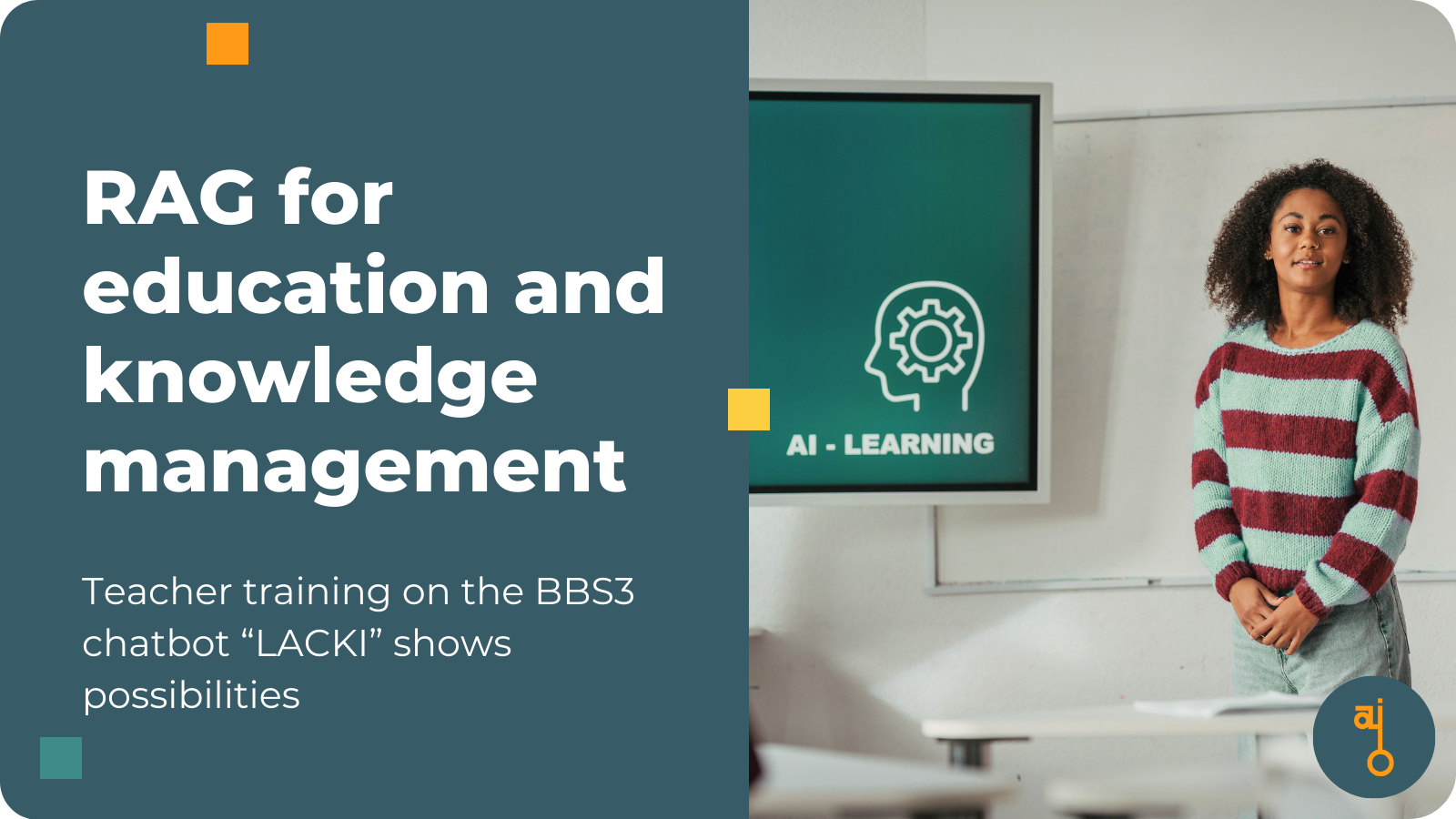
As part of an internal teacher training programme (SchiLf) at the BBS3 of the Hanover region DAISEC, together with the responsible FMF teaching team, provided practical insight into the use of a school AI chatbot in a vocational training context. The focus was on the BBS3 chatbot ‘LACKI’, which was developed in collaboration with the team at vehicle painters .
The FMF teaching team – Kathrin Lange, Dr. Uwe Herrmann, Rafael Libera and trainee teacher Teddy Seck – is working with AI expert Dren Fazlija to further develop the system. During the training course, the chatbot's functionality, application scenarios and security mechanisms were presented and tested in practical use.
‘LACKI’ is designed as a prototype for the education sector and answers questions exclusively on the basis of a stored document database containing teaching materials. The system does not freely access Internet sources, but uses a clearly defined knowledge base. Answers are therefore technically verifiable and transparently documented with source references.
Technically, the approach is based on RAG (Retrieval-Augmented Generation)This technology combines the power of generative AI with targeted document access: content is not generated ‘from the model memory’ but retrieved from a maintained knowledge base and processed in the response. This offers considerable advantages for knowledge management – especially where reliable, verifiable and up-to-date information is required.

RAG as a key technology for knowledge management in various domains
From DAISEC's perspective, the ‘LACKI’ project exemplifies the potential of RAG systems far beyond the school context, as the approach can be transferred to many fields of application. It is crucial that knowledge is domain-specific, controlled, maintained and provided on a source-based basis. RAG technology creates a robust foundation for this and at the same time enables low-threshold access.
The participants tested various document retrieval options and, in a discussion round, compiled a list of requirements for a chatbot in a vocational training context. The underlying database can be expanded and continuously improved by the team with password protection.
The training session at BBS3 made it clear: The use of RAG-based assistance systems such as ‘LACKI’ can not only support teaching, but also serve as a model for modern, secure knowledge management in various subject areas.