
DAISEC and the Potsdam Chamber of Crafts tested a smart optimisation system for the planning of the vocational training centre
How can courses, classrooms, teaching staff and timetables be coordinated in such a way that as many requirements as possible are met? How can existing resources be utilised more effectively? And how can the planning process respond quickly if a teacher is absent or other circumstances change at short notice? Together, the Potsdam Chamber of Skilled Trades and DAISEC investigated how intelligent optimisation methods can assist with these complex planning tasks.
From sharing experiences to a concrete project
The collaboration between the Potsdam Chamber of Skilled Trades and the European Digital Innovation Hub DAISEC began during the HPI Contact Programme 2025 in Trier. In a two-hour workshop, around 20 representatives from educational institutions affiliated with trade organisations shared their experiences of timetable and room planning.
This revealed a common problem: in many places, planning is still largely manual, labour-intensive and dependent on the practical knowledge of individual staff members. This exchange gave rise to the first points of departure for further cooperation.
For the Potsdam Chamber of Crafts, this discussion coincided with a specific development project: it commissioned the development of its own planning software for its vocational training centre. This presented an opportunity not only to digitise existing processes but also to assess where modern AI and optimisation techniques could deliver added value.
Lots of requirements, the best possible plan
The new software faces a challenging task, as numerous factors must be taken into account simultaneously during the planning process. Rooms vary in terms of facilities and capacity, whilst teaching staff differ in terms of availability and qualifications. Added to this are school holidays, exams, student numbers, specific sequences of teaching content and other resources. At the same time, different priorities must be weighed up. The software is designed to support those responsible for planning in this process – not to replace their decisions.
This is precisely where DAISEC’s knowledge transfer came into play. The first step was to work together to investigate which technological methods were suitable for this task. The choice fell on Constraint Optimisation, that is, optimisation under specified conditions.
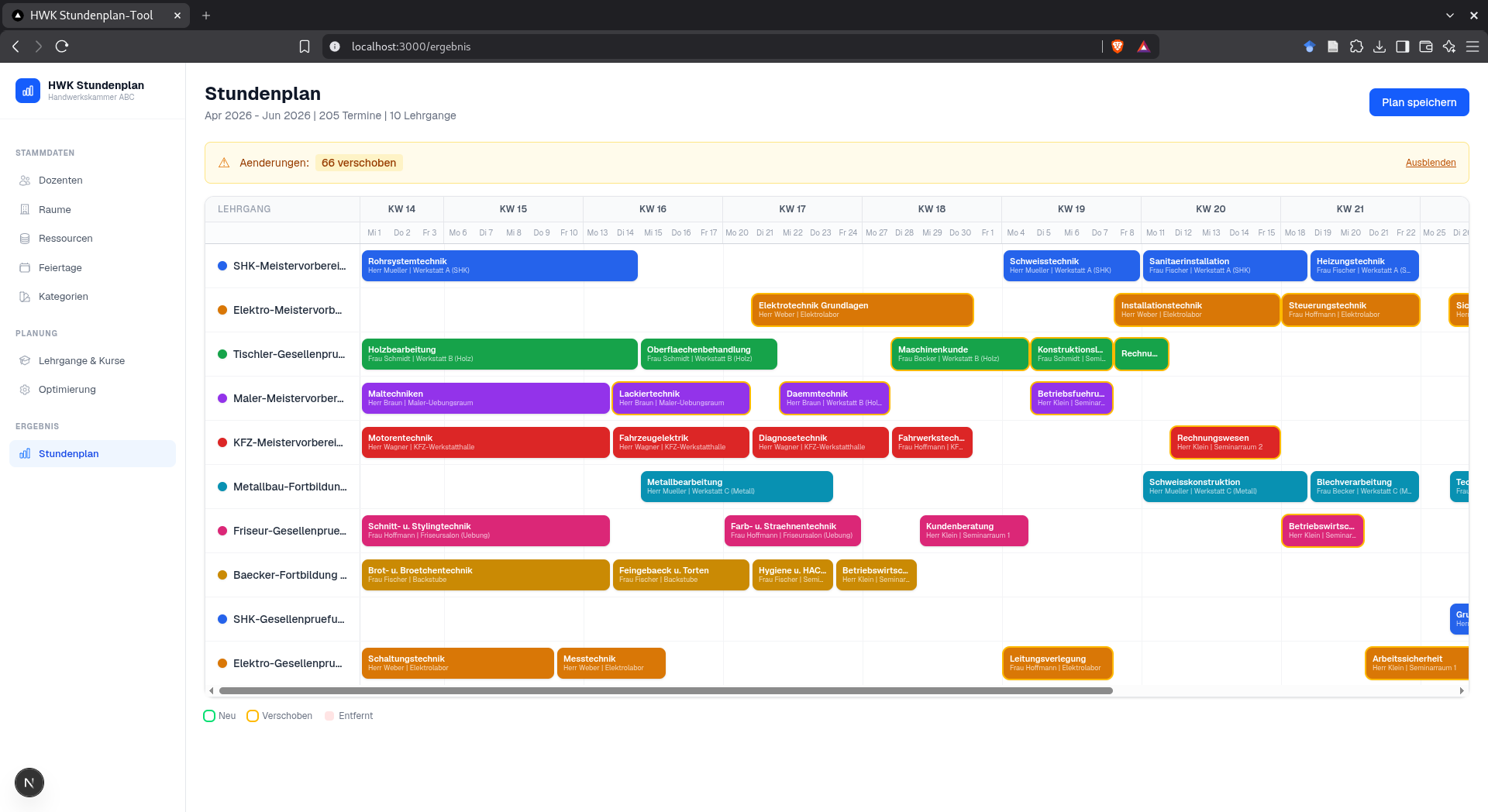
The principle can be compared to a large jigsaw puzzle: the software knows the individual pieces – courses, rooms, people and times – as well as the rules governing how they can be fitted together. For example, a room must not be double-booked, a teacher must be available, and certain lessons must take place in the correct order. An optimisation algorithm can examine a vast number of possible combinations and use them to generate the best possible timetable proposal.
Use AI specifically where it adds value
One key insight from our joint work is that not all planning software needs to become an ‘AI application’. Many functions, such as entering master data or displaying finalised plans, can be carried out reliably using traditional software. Intelligent optimisation methods are particularly useful where numerous conditions and priorities need to be weighed up against one another simultaneously.
DAISEC contributed its technological expertise to this project and used a demonstrator to investigate the fundamental feasibility. The focus was on whether the rules and resources of a vocational training centre could be modelled in such a way that an optimisation process could generate useful planning proposals from them.
A particular challenge in this regard was to formulate the numerous practical requirements in such a way that they could be processed technically. Which conditions must be strictly adhered to? Where is there room for manoeuvre? And which criteria determine whether one plan should be preferred over another? It thus became clear that meaningful optimisation depends not only on the technology, but also on a precise description of the actual planning processes.
From planning to flexible rescheduling
This approach is particularly interesting when it comes to short-term changes: what happens if a teacher falls ill? Which lessons can be rescheduled? Which classrooms and teachers are available as alternatives? An optimisation component could, in future, not only highlight emerging conflicts but also directly suggest possible alternatives for rescheduling.
This collaborative approach thus demonstrated a practical way of utilising AI: not to incorporate as much AI as possible into an application, but to deploy it where it can better solve a specific, complex task and effectively support those responsible for planning.
This collaborative work thus lays the foundations for the further development of the planning software, whilst also demonstrating how knowledge can be transferred between practical experience and AI expertise.
Your DAISEC contact
If you have any questions or would like to learn more about how the chatbot can be used in the classroom, please feel free to contact us.

Expert for Artificial Intelligence