

How do you find a prefabricated house that truly meets your needs? The Dream Home Assistant shows how artificial intelligence (AI) can support the process from identifying your requirements to selecting the right house.
High demand, complex advisory situations
Two companies in the prefabricated housing sector are facing a challenge: demand for housing is growing, whilst at the same time the consultation process is time-consuming. Many customers find it difficult to articulate their requirements, which makes it harder to assess their needs. However, there is also significant potential: standardised digital processes can reduce costs and make it easier for customers to find suitable options.
The aim: AI-powered support tailored to individual needs
As part of the “Dream Home Assistant” project, DAISEC is working with two companies to develop an AI-powered prototype that systematically identifies customers’ basic needs and suggests suitable prefabricated homes. In the long term, this approach aims to ease the burden of the initial contact whilst offering customers an accessible overview of suitable house models. Furthermore, the prototype highlights the technical and organisational challenges that can arise during the development of a chatbot.
From customer request to recommendation: the prototype
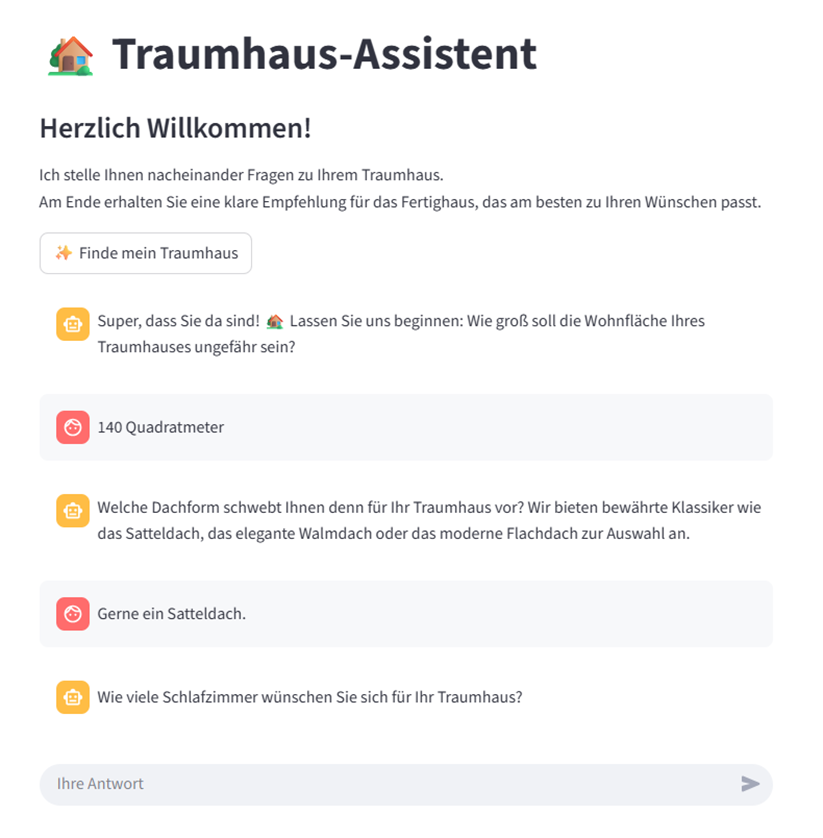
The prototype follows a clearly structured process in which several system components interact (see Figure 1). Customers begin the dialogue by freely describing their dream home. The chatbot then asks specific questions about the most important selection criteria, such as floor space, roof shape and the number of bedrooms (see Figure 2). These and other categories form the basis for the subsequent recommendation and enable a systematic assessment of the customer’s needs.
User inputs are collected and categorised within the dialogue and processing logic. The backend component controls the entire dialogue flow and generates a prompt from it, which is then sent to the AI model. The language model runs on a server and is accessed via an API key.
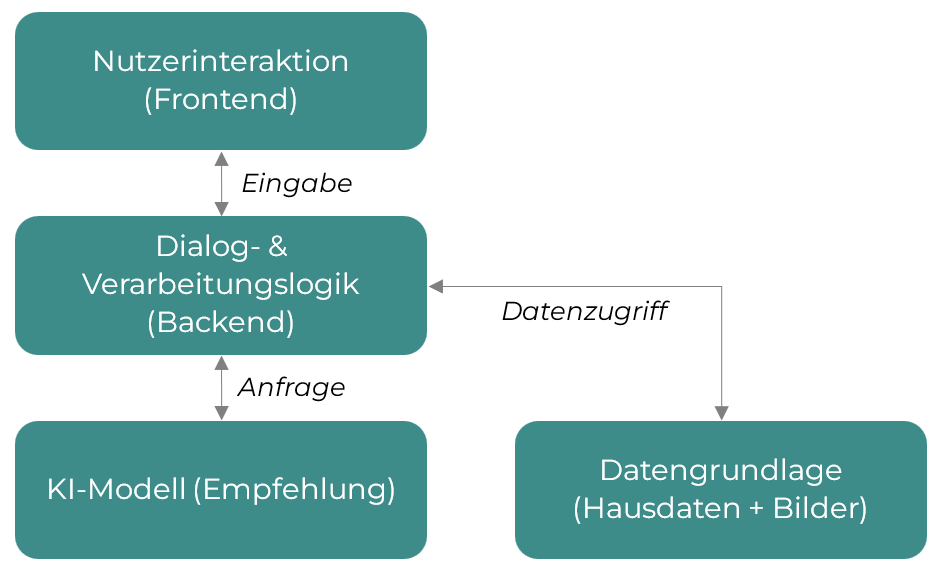
The AI model processes the structured customer requirements alongside a defined role description and the complete catalogue, which contains all available prefabricated house models meeting the same criteria. Based on this data, the model identifies the most suitable house and provides a reasoned recommendation.
Lessons Learned: Insights from the project
The development of a reliable AI chatbot often hinges on many small but crucial details. In particular, data quality, dialogue logic and the control of the AI model have a significant impact on the system’s reliability.
- Ensure data consistency: Even minor discrepancies between data and image files can lead to errors.
- Designing robust dialogue flows: Even unclear or incomplete inputs should be handled appropriately.
- Validate inputs: Responses should be checked for plausibility, completeness and logical consistency.
- Formulate prompts precisely: even small changes to the wording can significantly alter the AI’s response.
- Avoiding hallucinations: The model should be strictly limited to the existing data set.
It is not only the underlying technical architecture, but above all the careful development of many individual components that determines whether a chatbot can be used reliably.
Your DAISEC contact
If you have any questions or would like to find out more about how you can use AI chatbots in your business we’d be happy to help you get started with this cutting-edge technology.

Expert in Digital Transformation